Well, I'm getting close to the last ground tests needed, so I wanted to calculate how much heating or cooling I need for the long, cold journey. Heating or cooling satellites turns out to be very difficult, as even though it's very very cold (-40F, same as -40C) at high altitude, there's so little atmosphere (~1.2% of sea level's at 100,000 feet) that there's very little convection, or capacity for the atmosphere to remove heat from the capsule.
So the question is, what's going to win? It's really cold outside, but the capsule is 1.5 inches thick polystyrene, has two Android phones working hard, a thirsty external GPS chip and lithium sulphur batteries that get hot under load. There's a chance that the inside of the capsule gets hot and can't release its heat, and if the temperature rises too much, the android phones start shutting down - not good.
I ran a full three hour simulation at room temperature and threw two small handwarmers in to see if they helped. The graph below shows what happened.
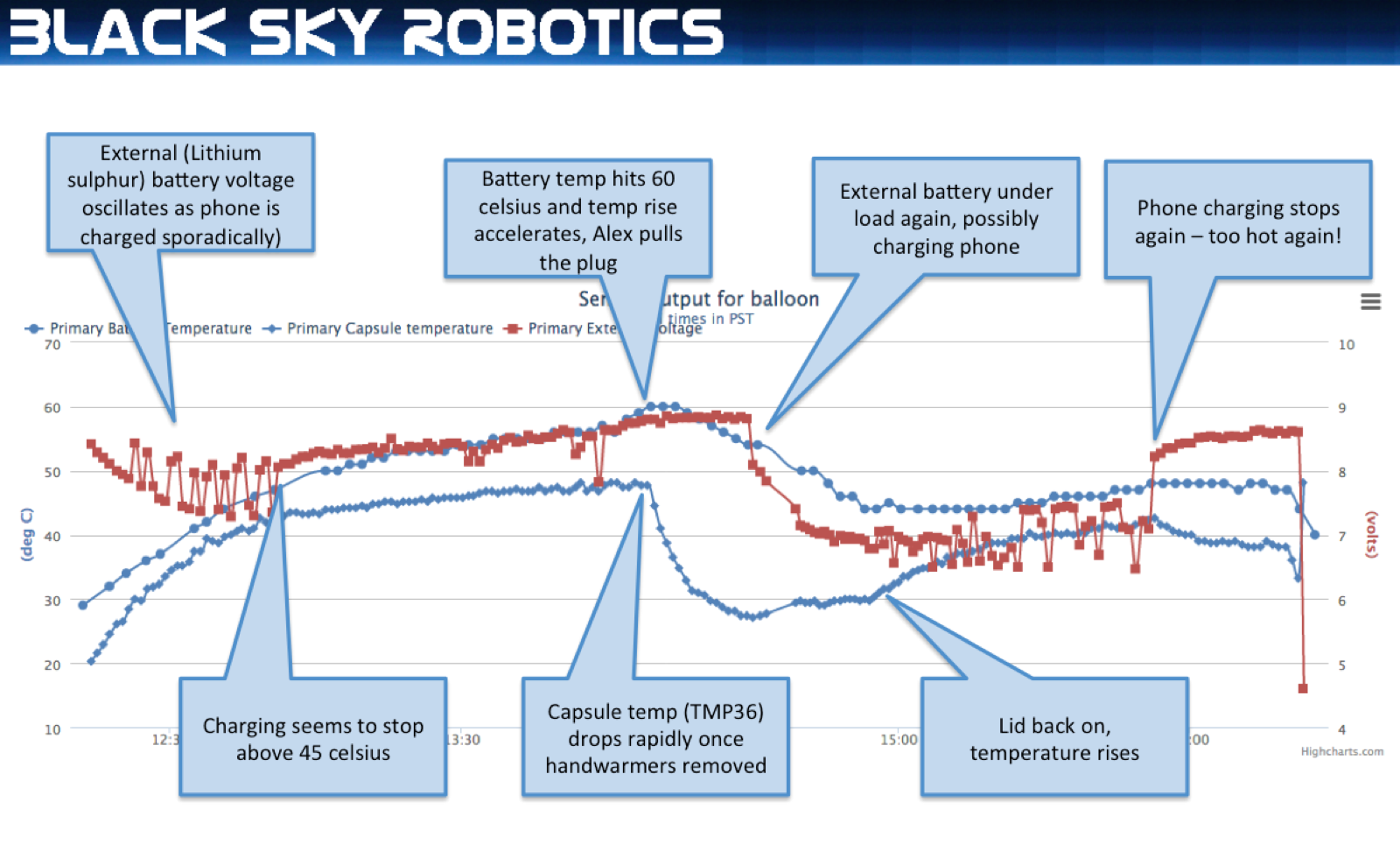
For the first 30 or so minutes, the temperature rises quickly, and the lithium sulphur battery voltage spikes as it goes in and out of load. I've seen this before - the Android phone that it's charging is at 100% battery, but to keep it at 100% battery, it tops itself up sporadically, creating the spiky voltages we see.
After about 45 minutes, the battery temperature passes 45C (pretty hot) and it looks as though the Android phone has decided to stop charging itself. They will do that because they don't want to charge with an overheated battery, and that's why most cellphone batteries now have a temperature sensor inside them. The temperature keeps rising though. I'm at a party by this point, nervously monitoring the temperature graph on my phone. After another hour, the battery temperature is 60C and the temperature rise appears to be accelerating, and I call the babysitter and get Alex to take the capsule lid off and remove the handwarmers. The capsule cools quickly, the battery takes longer, but it looks like the phone is charging again. I get home, and decide to put the lid back on to see if the temperature rises too quickly without handwarmers. Pretty quickly the temperature is above 45C and the phone stops charging again. Ugh! It's too hot in there.
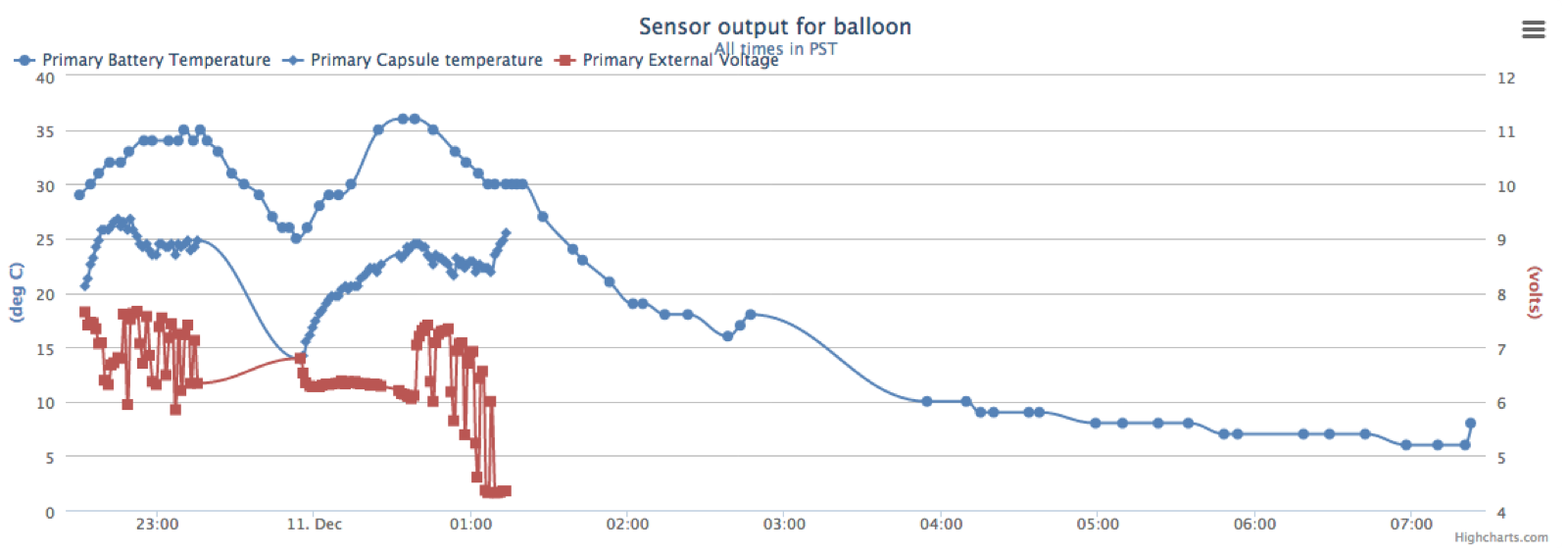
We've had overnight frost recently, so i stuck the capsule outside to see what happened with no hardwarmers, and much colder exterior temperatures (around 0C). The external lithium sulphur batteries were pretty discharged from the previous test and died after 2.5 hours (which is also when the simulation and a lot of load on the phone ends). I had a bad connection that i had to fix after 60-75 minutes, but otherwise the Android battery stayed pretty hot (36C) until the external lithium sulphur batteries died, then it took about 2 hours to drop 20C. That's pretty encouraging. With some rough math, if it was 0C outside for this test, at -40C outside temperature, sea level pressures, it would still take probably 30-40 minutes to drop 20C (the drop would be steeper and exponential decay at first). If my goal is to keep the temperature between 0 and 40C within the capsule, I may not even need handwarmers. I've 5-6 hours of life from the Lithium Sulphur batteries, so I might rig a simple electric heater triggered by battery temperature, and that might be enough.
Space is hard!